Every harvest season, something quiet and devastating happens across India's farms. A spinach farmer in Uttar Pradesh fills his crates before dawn. By the time that spinach reaches a Delhi sabzi mandi - two, sometimes three days later, crammed into a roadside tempo with no cold chain - a quarter of it has wilted beyond sale. He dumps it. He takes whatever the trader offers for the rest. He goes home having earned less than the cost of growing it.
This is not an isolated story. It is a national emergency hiding in plain sight.
India's ₹1,52,790 Crore Wound - And the Pause Button We Built for It
Every harvest season, something quiet and devastating happens across India's farms. A spinach farmer in Uttar Pradesh fills his crates before dawn. By the time that spinach reaches a Delhi sabzi mandi - two, sometimes three days later, crammed into a roadside tempo with no cold chain - a quarter of it has wilted beyond sale. He dumps it. He takes whatever the trader offers for the rest. He goes home having earned less than the cost of growing it.
This is not an isolated story. It is a national emergency hiding in plain sight.
According to a 2022 study conducted by NABARD Consultancy Services (NABCONS) - commissioned by India's own Ministry of Food Processing Industries - India loses approximately ₹1,52,790 crore worth of agricultural produce every single year to post-harvest losses. Fruits and vegetables account for the largest share of this damage, with losses ranging from 4.87% to 11.61% for vegetables and 6.02% to 15.05% for fruits across the post-harvest chain. A separate body of research puts the effective post-harvest loss in vegetables at close to 20% - meaning one in every five vegetables grown in this country never reaches a human stomach.
Ninety-seven percent of India's fruits and vegetables travel by road. Without refrigeration. Often for hundreds of kilometres.
This is the silent crisis Vedura Foods was built to solve.
The Problem Isn't the Farmer. It's the Infrastructure.
Let's be precise about what's actually failing here. India produced a record 369 million tonnes of horticultural output in 2024-25. Uttar Pradesh alone contributes 34.43 million tonnes of vegetables annually - the highest of any state. We are not a nation that cannot grow food. We are a nation whose post-harvest infrastructure has not kept pace with its agricultural ambition.
The consequences ripple outward in three directions:
For the farmer, it means Distress Sales. When a seasonal surplus hits the mandi, prices collapse. A farmer who grew chillies for months receives ₹2 per kilo. If he can't sell quickly, the crop rots. There is no pause button. There is no option to wait for a better price. The spoilage clock is ticking from the moment of harvest.
For the consumer, it means nutritional bankruptcy. Fresh spinach traveling 500 km in a non-refrigerated vehicle loses significant amounts of its vitamins before it reaches a kitchen counter. You're paying for "fresh," but you're getting a nutritionally depleted shadow of what was harvested.
For the nation, it means a chronic food security gap. India's vegetable production - even at record levels - only yields an effective 165.77 million tonnes after accounting for post-harvest losses. Against a national requirement of 209.74 million tonnes, this gap is not trivial.
The Vedura Thesis: Economic Time-Shifting
At Vedura Foods, we came at this problem from a different angle. Instead of asking "how do we move food faster?" - we asked a more fundamental question: what if the farmer didn't have to move it at all?
Our answer is what we call Economic Time-Shifting. By deploying Polyhouse Dehydration Technology directly at the farm-gate, we give the farmer the ability to transform a highly perishable crop into a shelf-stable, high-value product - on-site, within 48 hours of harvest, before a single rupee is lost to spoilage.
The math is striking. A farmer selling wet spinach at the mandi earns roughly ₹5 per kilogram. The same spinach, dehydrated at the farm gate, becomes a concentrated, nutrient-preserved product worth 5x to 10x more per gram. Transport weight drops dramatically, reducing logistics costs. Shelf life extends to 12 months. And critically - the farmer is no longer racing against rot. They own time.
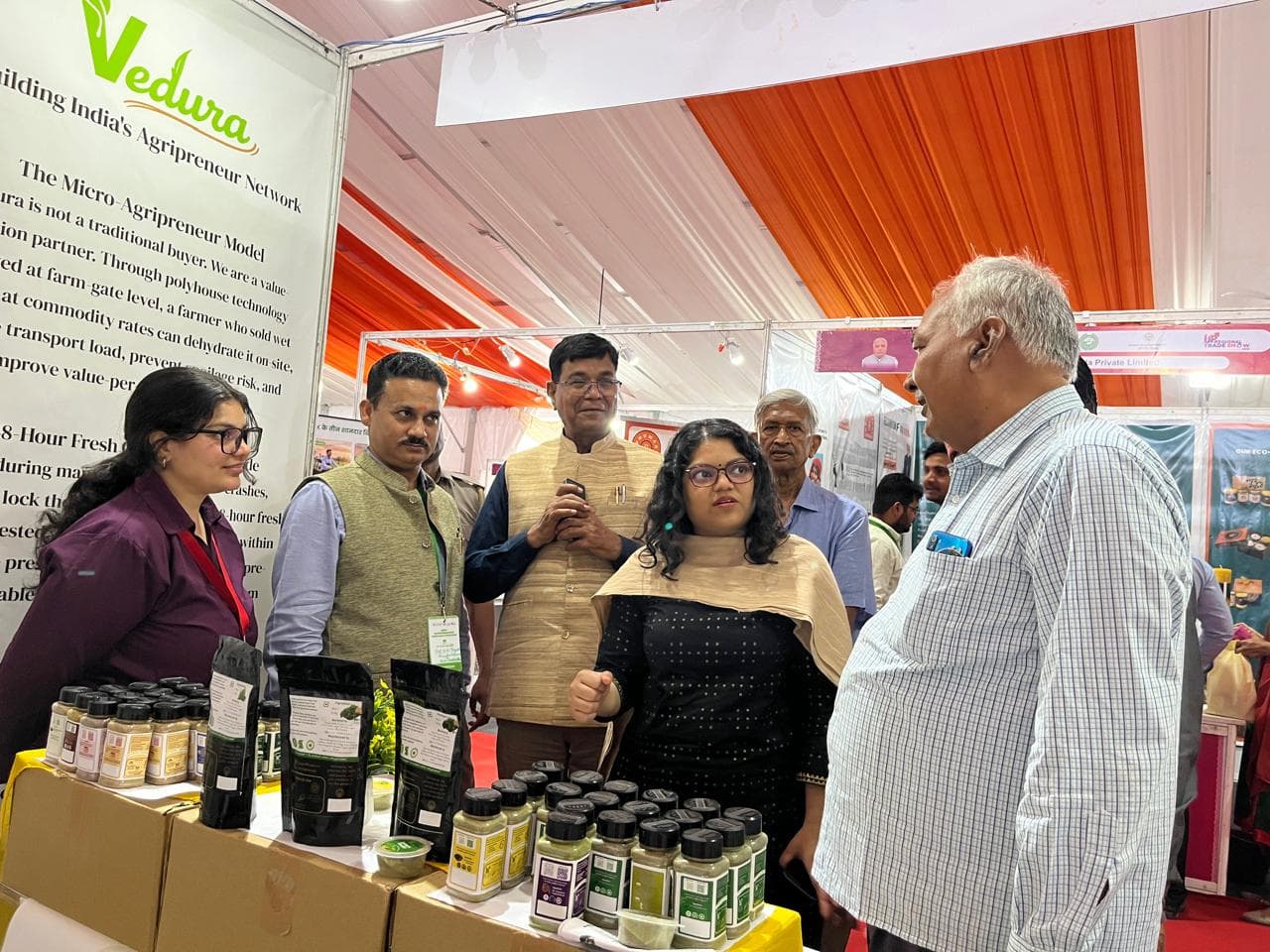
This is not contract farming. The farmer isn't just a raw material supplier to us. Under the Vedura model, the farmer is a micro-agripreneur - running a processing unit, controlling quality, and selling to us at a pre-agreed Fair-Trade price, insulated from mandi volatility. We train them in Scientific Dehydration Management: moisture testing protocols, hygiene standards, and what we call Goldilocks Zone temperature control - hot enough to remove water, cool enough to preserve enzymes, chlorophyll, and micronutrients.
The Numbers Align With the Moment
The timing of this model matters. India is at an inflection point. The government's Pradhan Mantri Kisan Sampada Yojana - the flagship food processing infrastructure scheme - has already sanctioned 1,185 projects nationwide, driving over ₹21,900 crore in investment and benefiting 51 lakh farmers with over 7 lakh direct and indirect jobs. Under PMKSY alone, 94 projects were operationalised in 2025, adding 28.48 lakh MT of processing and preservation capacity.
The policy environment is actively rewarding what Vedura is doing. The government's Production Linked Incentive scheme for food processing carries an outlay of ₹10,900 crore. The PM Formalisation of Micro Food Processing Enterprises scheme has supported over 200,000 MSMEs in the food processing space.
Meanwhile, India's food processing sector - currently processing less than 10% of its agricultural output - is projected to reach $535 billion by 2025-26. High-value horticulture crops have already grown at nearly twice the pace of cereal crops over the past decade.
The infrastructure for the agripreneur revolution is being built. Vedura is building the human layer on top of it.
What the Captured Harvest Means for You
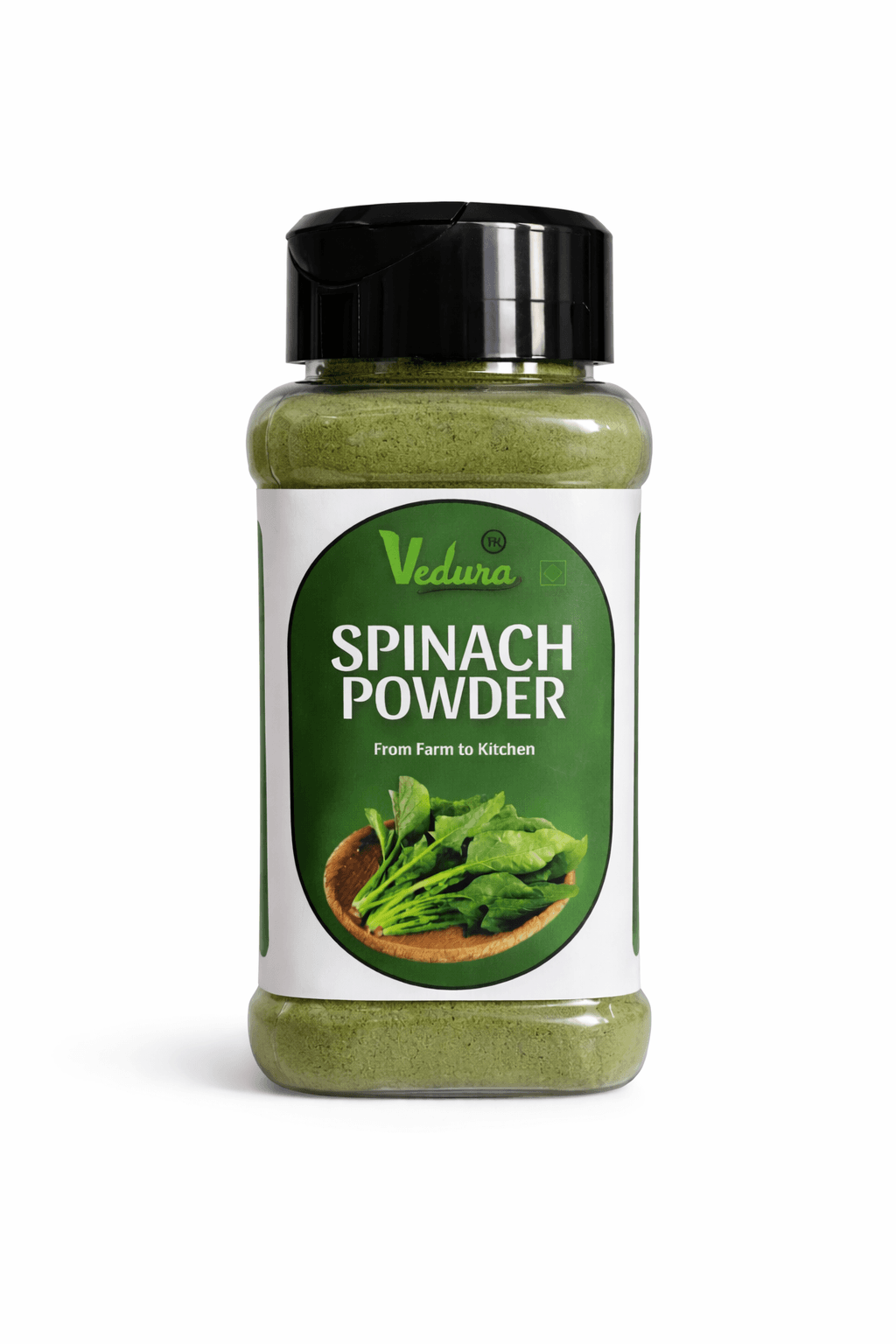
For the urban consumer, Vedura's dehydrated greens aren't a compromise. They're a correction. The spinach in our pack was dried within hours of leaving the soil - preserving the enzymes, chlorophyll, and nutritional density that conventional supply chains slowly destroy over three to five days of hot-road transit.
No washing. No wilted stems. No kitchen waste. Every gram you pay for is 100% usable.
India grows enough to feed itself generously. It simply needs better infrastructure between the field and the plate. That infrastructure - decentralised, farmer-owned, and science-backed - is what Vedura is building, one agripreneur at a time.
FAQs
How much food does India lose after harvest?
Estimates of India's annual post-harvest losses run into the region of Rs 1.5 lakh crore, driven largely by inadequate storage, cold chain, and processing infrastructure between farm and plate.
Why does so much produce go to waste in India?
Most loss happens because perishable produce has nowhere to go at harvest-time gluts - there is not enough decentralised processing or preservation close to the farm.
How does dehydration reduce food waste?
Dehydration converts perishable seasonal surplus into shelf-stable products with a long shelf life, capturing value that would otherwise rot - the model behind our dehydrated greens.
What is an agripreneur?
An agripreneur is a farmer or rural entrepreneur who adds value to produce through processing, branding, or market access rather than selling raw commodity - explored in our agripreneur feature.
Vedura Foods is a Prayagraj-based food innovation company working at the intersection of agripreneurship, bio-preservation technology, and rural value creation.
Explore topics
Continue your Vedura journey
Explore product pages, practical recipes, and research-led explainers connected to this topic.
Comments
Be the first to comment.