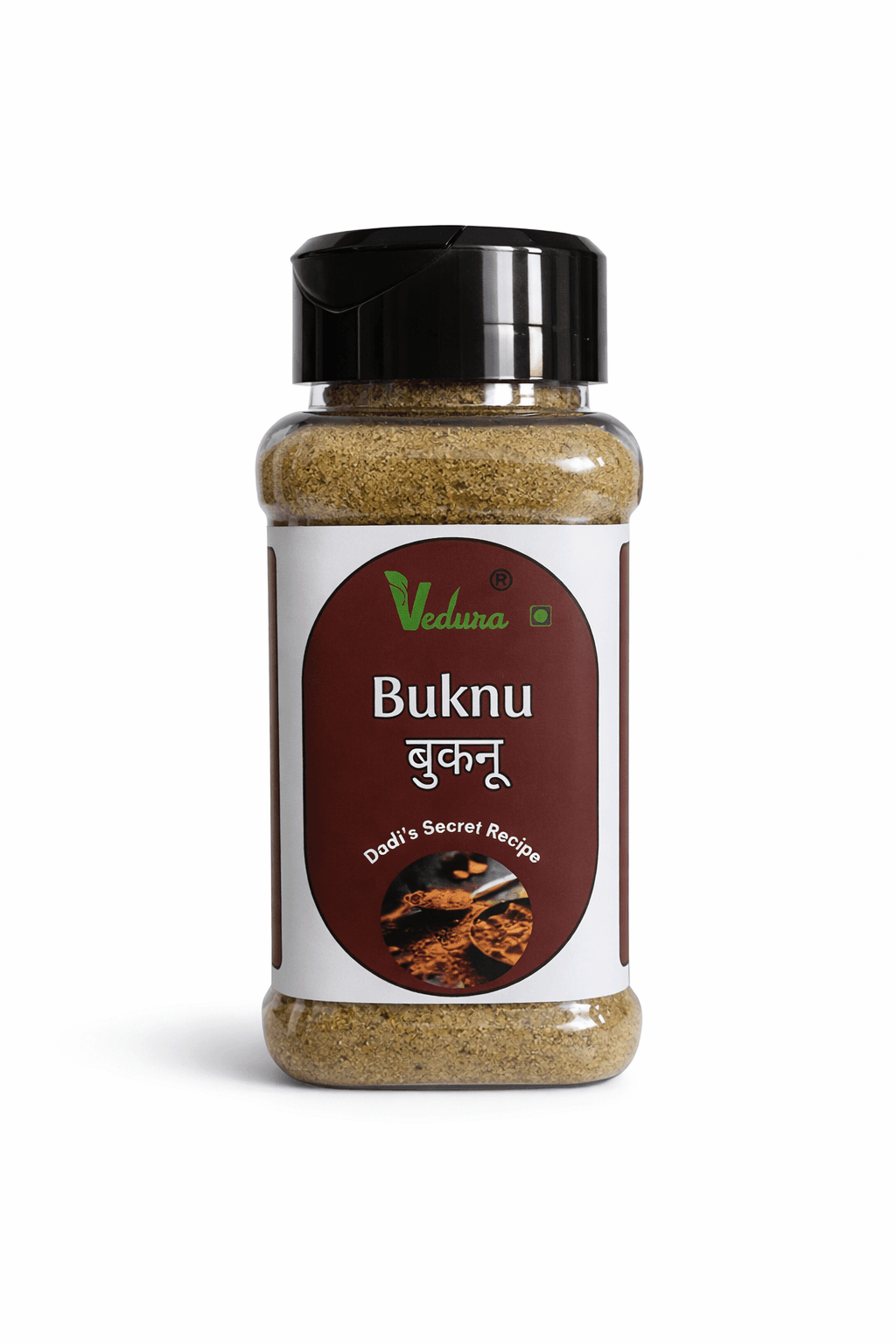

**Quick summary:** Buknu is a traditional powdered spice blend from Kanpur, Uttar Pradesh, made from 12+ whole spices. It is used as a finishing condiment on fruits, chaat, lassi, raita and salads — and historically as an everyday digestive aid. Unlike commercial chaat masala, authentic Buknu is stone-ground to preserve aromatic oils, and its ingredient ratio is different from anything you will find on a supermarket shelf.
If you grew up in eastern Uttar Pradesh, Buknu was the small tin that lived near the dining table, not the spice cabinet. If you did not — this guide will tell you everything you need to know to cook with it confidently.
What is Buknu Masala? The Complete Guide to India's Best-Kept Spice Secret
Quick summary: Buknu is a traditional powdered spice blend from Kanpur, Uttar Pradesh, made from 12+ whole spices. It is used as a finishing condiment on fruits, chaat, lassi, raita and salads — and historically as an everyday digestive aid. Unlike commercial chaat masala, authentic Buknu is stone-ground to preserve aromatic oils, and its ingredient ratio is different from anything you will find on a supermarket shelf.
If you grew up in eastern Uttar Pradesh, Buknu was the small tin that lived near the dining table, not the spice cabinet. If you did not — this guide will tell you everything you need to know to cook with it confidently.
Table of Contents
1. What is Buknu?
2. History and origin
3. Key ingredients of authentic Buknu
4. Buknu vs chaat masala — what's the difference?
5. Health benefits
6. How to use Buknu in everyday cooking
7. Where to buy authentic Buknu online
8. Frequently asked questions
1. What is Buknu?
Buknu — also written Buknoo or Buknu Masala — is a regional Indian spice powder native to the Kanpur region of Uttar Pradesh. At its core it is a finely ground blend of over a dozen spices: cumin, amchur (dry mango powder), black pepper, ajwain (carom seeds), sendha namak (rock salt), kala namak (black salt), dry ginger, coriander, fennel, asafoetida, cardamom and turmeric.
But calling Buknu "a spice blend" undersells it. In UP households it plays three simultaneous roles: a finishing condiment (sprinkled on fruit, chaat, lassi, raita), an everyday digestive (taken after heavy meals), and a cultural signifier — the kind of thing your grandmother's tin looked exactly like.
Buknu is not cooked with. It is always added at the end or served alongside. Heat dissipates its aromatic oils, and those oils are the entire point.
2. History and Origin
Buknu is generally associated with Kanpur and the surrounding belt of central-eastern UP — Prayagraj, Lucknow, Varanasi — where it was made at home in small batches. The classical formulation predates industrial spice processing by a long way. Elders in the region describe it as something that was never bought; it was always ground fresh, often by the oldest woman in the household, using a *sil-batta* (stone mortar and pestle).
The stone-grinding matters. A high-speed industrial mill generates heat that strips the volatile oils from spices like fennel, cardamom, and ajwain. Traditional stone grinding keeps the temperature low enough that the aroma survives intact. That is why authentic Buknu smells the way it does — and why mass-market chaat masalas, which are made on industrial mills, do not.
3. Key Ingredients of Authentic Buknu
| Ingredient | Hindi Name | Role in the Blend |
|---|---|---|
| Dry Mango Powder | Amchur | Tangy sourness |
| Cumin Seeds | Jeera | Earthy warmth, aids digestion |
| Black Pepper | Kali Mirch | Heat; boosts nutrient absorption |
| Carom Seeds | Ajwain | Gut-health herb, distinctive flavour |
| Rock Salt | Sendha Namak | Mineral content, cleaner than table salt |
| Black Salt | Kala Namak | Umami, sulphurous depth |
| Dry Ginger | Sonth | Warming, digestive |
| Coriander | Dhania | Cooling, citrus notes |
| Fennel | Saunf | Sweetness, freshness |
| Asafoetida | Hing | Umami, strong digestive aid |
| Cardamom | Elaichi | Aromatic, cooling |
| Turmeric | Haldi | Colour, anti-inflammatory |
These twelve are the backbone. Individual household recipes sometimes add harad or baheda (triphala components) for additional digestive support.
4. Buknu vs Chaat Masala — What's the Difference?
This is the most common question we get. The short answer: chaat masala is acid-forward, Buknu is aromatic-forward.
| | Buknu | Chaat Masala |
|---|---|---|
| Dominant flavour | Aromatic, warm, digestive | Tangy, sour, salty |
| Processing | Traditionally stone-ground | Industrially milled |
| Use case | Finishing condiment; also a digestive after meals | Street snacks (chaat, fruit chaat) |
| Spice count | 12+ | Usually 6–8 |
| Heat character | Mellow, peppery, slow-building | Sharp, immediate, acidic |
Both have their place. If you already love chaat masala, Buknu is not a replacement — it is an upgrade that unlocks a different flavour register.
5. Health Benefits
Buknu contains a stack of well-documented digestive spices: cumin (supports metabolism), ajwain (a classical carminative that relieves bloating), black pepper (increases curcumin bioavailability by up to 2,000%), and hing (used for centuries in Ayurveda for digestive complaints).
Amchur contributes vitamin C. Sendha namak and kala namak are mineral-rich and far more nutritionally interesting than refined white salt. Turmeric adds anti-inflammatory support, and when paired with the black pepper inside the blend, its curcumin is dramatically better absorbed than turmeric alone.
In traditional Ayurvedic practice, Buknu is classed as a *pachaka* — a digestive stimulant. This is not a medicine, but a daily-use flavour carrier that happens to be built on functionally beneficial spices.
“**Note:** Consult your doctor before making dietary changes if you are pregnant, nursing, or on medication — especially if you take blood-thinners (turmeric and ginger can interact).”
6. How to Use Buknu in Everyday Cooking
Buknu is a finisher. Keep the tin near the table, not near the stove.
- On fresh fruit — mango, guava, papaya, watermelon. A pinch changes everything.
- On lassi and raita — ½ tsp stirred into a glass of salted lassi is the classic UP afternoon drink.
- On salads — sprinkle over cucumber, onion, tomato for an instant Indian-style salad.
- On chaat and snacks — use in place of chaat masala on pakora, samosa, aloo tikki.
- On toast or butter — sounds odd, tastes excellent.
- On eggs — a light dusting on an omelette or boiled eggs transforms the flavour.
Start with ¼ tsp per serving and build up. The flavour is more concentrated than chaat masala.
7. Where to Buy Authentic Buknu Online
When buying Buknu online, look for the following markers of quality:
- Stone-ground preparation — preserves aromatic oils
- No artificial colours, preservatives or anti-caking agents
- Origin traceable to the UP region (Kanpur/Prayagraj/Lucknow belt)
- FSSAI licence number printed on the pack
- Resealable pouch — amchur absorbs moisture quickly once opened
Vedura Foods produces Buknu Masala using the traditional 12-spice formulation, stone-ground and packed fresh in Kanpur. Available on the Vedura Buknu product page or on the Vedura Amazon store.
8. Frequently Asked Questions
Q: Is Buknu the same as chaat masala?
A: No. Buknu is aromatic and digestive-forward; chaat masala is acid-forward. The spice ratios and the grinding method are different.
Q: Can I cook with Buknu?
A: It is best as a finishing condiment. Heat dissipates the volatile oils. If you must add it during cooking, add in the last 30 seconds only.
Q: How long does Buknu last once opened?
A: Resealed tightly and kept away from humidity and direct sunlight, 12 months from packaging. Amchur is the most moisture-sensitive ingredient, so keep the pouch dry.
Q: Is Vedura Buknu preservative-free?
A: Yes. 100% natural with no artificial colours, flavours, preservatives or anti-caking agents.
Q: Can children have it?
A: Yes, in small amounts. It is not spicy in the chilli sense; the pepper gives a gentle warmth that most children enjoy.
Buknu is one of the small, specific pleasures that disappears from a cuisine when people stop cooking at home. It is worth bringing back into your kitchen — both for the flavour and for what it represents: a spice tradition built on function, not fashion.
For more on why this digestive blend deserves a place over plain table salt, see why table salt is failing you, or browse Vedura's full range of natural spices and dehydrated greens.
Explore topics
Continue your Vedura journey
Explore product pages, practical recipes, and research-led explainers connected to this topic.
Comments
Be the first to comment.